Advances in Cancer Nanotheranostics: Translational Progress and Organ-Specific Strategies in Precision Oncology
Keywords:
Nanotheranostics, multi-organ cancer, precision oncology, imaging-guided therapy, targeted drug delivery, clinical translationAbstract
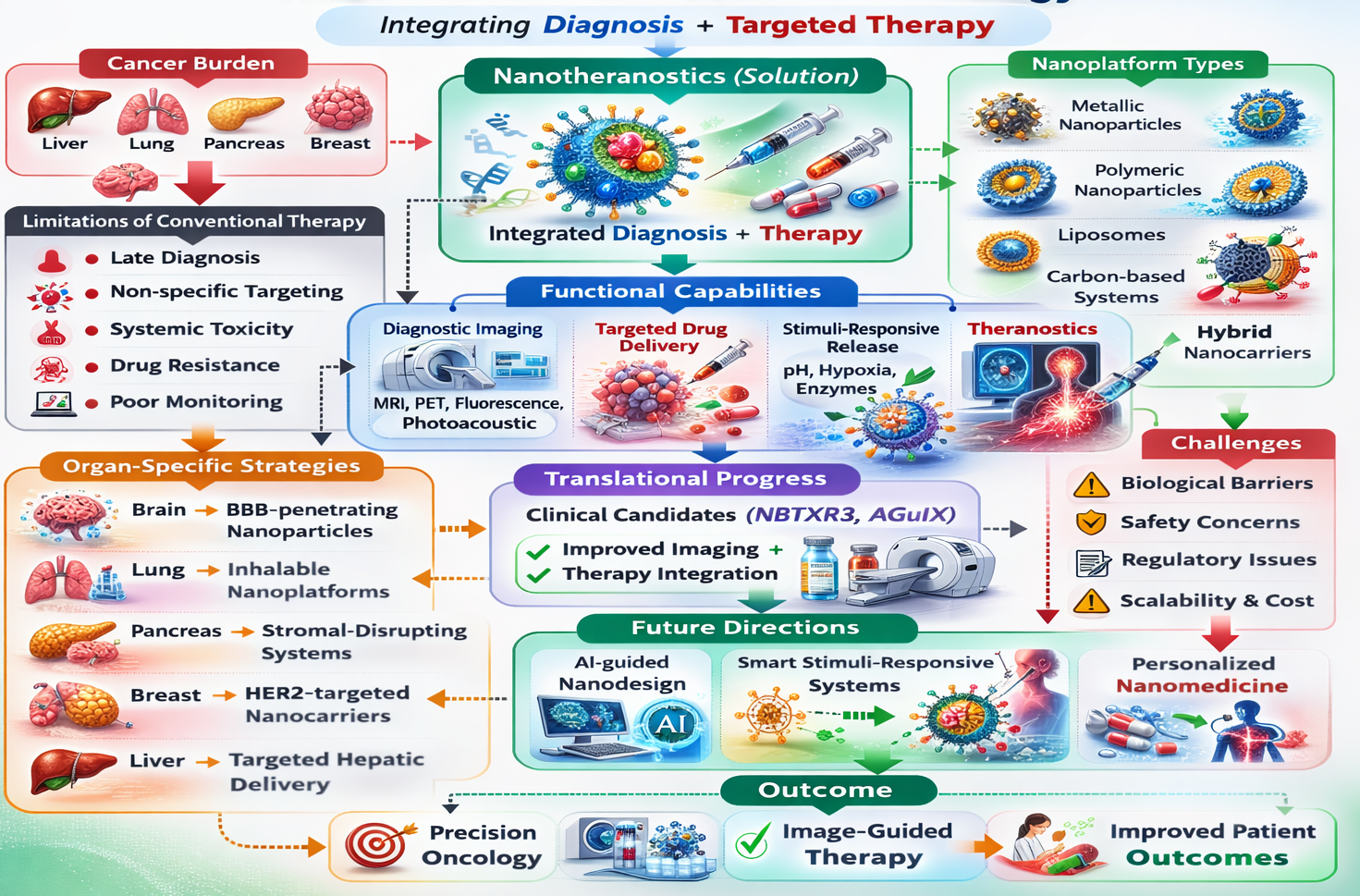
Cancer remains a major global health burden, with liver, lung, pancreatic, breast, and brain cancers contributing significantly to morbidity and mortality. Conventional therapeutic strategies are often limited by late diagnosis, non-specific targeting, systemic toxicity, and the development of drug resistance, resulting in suboptimal clinical outcomes. Additionally, poor tumor selectivity, low therapeutic efficacy, and the lack of real-time monitoring further constrain the effectiveness of traditional treatment modalities. In this context, nanotheranostics has emerged as a promising approach that integrates diagnostic imaging and targeted therapy within a single platform. Various nanoplatforms, including metallic nanoparticles, polymeric nanoparticles, liposomes, carbon-based systems, and hybrid multifunctional nanocarriers, have been developed to enhance treatment precision. These systems enable advanced functional capabilities such as multimodal imaging (MRI, PET, fluorescence, and photoacoustic imaging), targeted drug delivery, and stimuli-responsive drug release triggered by tumor-specific conditions such as pH, hypoxia, and enzymatic activity. Organ-specific strategies have further improved therapeutic outcomes, including blood–brain barrier-penetrating nanoparticles for brain tumours, inhalable nanoplatforms for lung cancer, stromal-disrupting systems for pancreatic tumours, HER2-targeted nanocarriers for breast cancer, and liver-targeted delivery systems. Recent translational progress highlights clinically relevant nanotheranostic platforms such as NBTXR3 and AGuIX, demonstrating improved integration of imaging and therapy. Despite these advances, challenges, including biological barriers, safety concerns, regulatory complexities, and scalability issues, remain. Future developments focusing on AI-guided nanodesign, smart stimuli-responsive systems, and personalized nanomedicine are expected to drive the transition toward precision oncology, enabling image-guided therapy and improved patient outcomes.