From Bench to Bedside: AI and Nano therapeutics Driving Personalized Cancer Treatment
Keywords:
nanotherapeutics; artificial intelligence; precision oncology; liver cancer; breast cancer; renal cell carcinoma; glioblastoma; multi-omics; personalized medicineAbstract
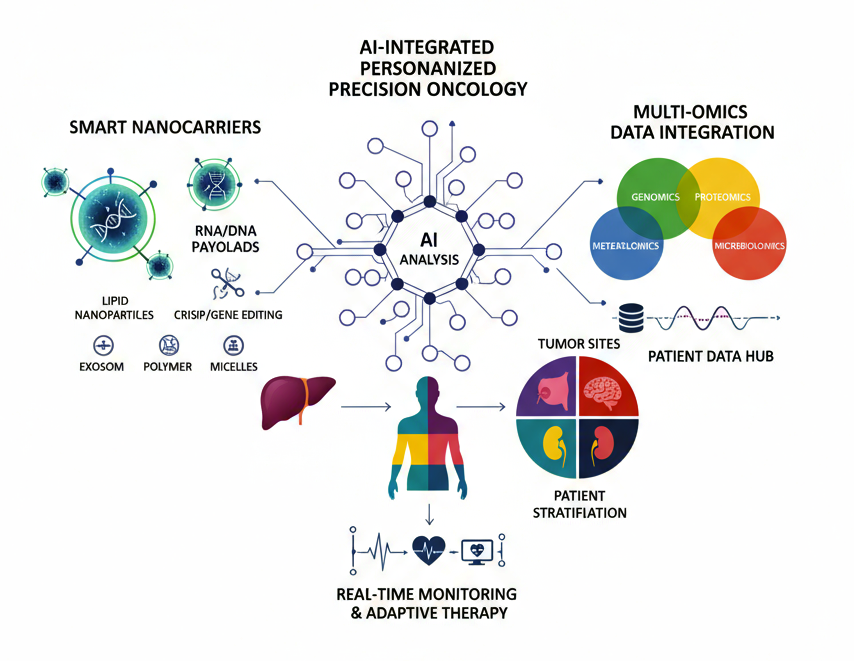
Background: Personalized oncology has advanced significantly between 2019 and 2024, driven by the integration of nanotherapeutics and artificial intelligence (AI). Together, these innovations promise to overcome tumor heterogeneity, drug resistance, and delivery challenges, paving the way for individualized cancer therapy. Objectives: This review synthesizes recent progress in AI-integrated nanomedicine across liver, breast, renal, and brain cancers, emphasizing smart nanocarrier design, multi-omics-driven personalization, and translational advances. Methods: Literature published between 2019 and 2024 was analyzed to identify trends in nanoparticle engineering, AI-guided drug design, omics integration, and clinical applications. Representative preclinical and clinical studies were reviewed to highlight innovations and translational gaps. Results: Advances include stimuli-responsive and ligand-targeted nanocarriers, RNA- and CRISPR-based therapeutics, and nano-immunotherapy combinations. AI applications span target identification, nanoparticle optimization, patient stratification, and outcome prediction. Translational progress is most notable in breast and liver cancers, with early trials demonstrating safety and efficacy, while renal and neuro-oncology face greater challenges in clinical adoption. Conclusions: AI-integrated nanotherapeutics are transforming the landscape of precision oncology, offering tailored interventions across multiple cancer types. Future progress will depend on omics-driven personalization, adaptive trial frameworks, scalable manufacturing, and global access strategies. Together, these efforts position nanomedicine and AI as central pillars in the evolution of personalized cancer therapy.